
Mixed and Balanced Dog training – the Middle Way
What is Balanced Dog Training? It’s the Middle Way, mixing traditional training and positive reinforcement. Learn more about how a mixed (whole) training style can help you and your dog by exploring the pages on OC Dog Training – By Andrew Ledford 714-827-4058
Dog training the middle way.
The articles on this site will help you recognize which styles of dog training will work best for you and the canine companion(s) you care for. Some people call this style of training, mixed dog training or balanced dog training.
I am influenced by this quote from Bruce Lee "Absorb what is useful, discard what is not, add what is uniquely your own.”
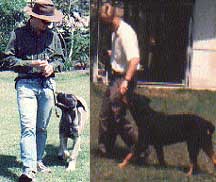
Integrated multisensory (balanced) dog training uses both traditional leash and collar training combined with food reinforcement or other forms of positive reinforcement. Some other types of reinforcement I like to incorporate into the training include, praise, play, and walks. We also work on sharpening observation skills and expanding a person’s orientation to the dog and to training.
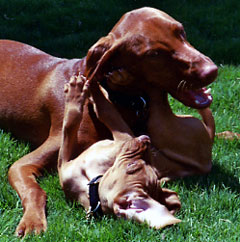
Whole or balanced dog training starts with the pet’s natural characteristics and physical state (genetic history, basic needs, individual temperament, health, etc.…).
Vizslas in a balanced training program
The next consideration is your pet’s social environment and social skills. A large part of the social environment are the people in the house.
Teaching techniques and their application are the third aspect of a complete pet education program.
Teaching techniques can be either hard or soft. What’s important is to blend all aspects of the dog’s development into a harmonious whole. Often the actual technique is not as important as how the technique is used. A complete owner/dog education program contains both soft and hard techniques.
How you blend and balance these three elements can make the difference between an ill-mannered or well-mannered pet.
It is my belief that most pet dogs should have some type of leash work, either traditional leash and collar work, or conditioning with one of the newer head collars. I almost always use both in my private training programs. Some owners really need to use the head collar to overcome their own leash handling habits. Learning proper leash handling is a matter of safety, even if you do not use a leash base training system. This is especially true for senior dog handlers.
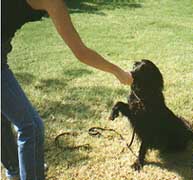
Next I strongly advocate the use of reinforcement based teaching systems. The primary reinforcement I use is food. But play can be very useful for some dogs.
Reinforcement Training in a Comprehensive Mixed Dog training Program.
Most mixed dog training systems use social praise. Social relationship conditioning is built around touch exercises as well as the give and take of ritualized interactions. If done properly touch can help calm a dog and is sometimes used for reassurance. If done improperly touch can increase anxiety.
Another aspect of a mixed / balanced dog training program is a type of conditioning based primarily on the social relationship between the owners and the pet. The formal training techniques of the dog training process are the tools most people need to reach or come closer to improving the social relationship. When beginning a training program I feel that leash work and reinforcement work should be started separately. I like to teach leash handling as a separate skill in the beginning because new handlers are usually under high cognitive load. This translates into having a hard time holding the leash in the proper, safe manner while also focusing on using food reinforcement properly. The Social Relationship work should be incorporated into all canine development programs from the start.
Our programs are primarily directed toward educating household pets and their owners. Owner/pet education programs are designed to teach basic obedience, life skills, house manners, how to prevent future behavior problems from developing, and how to solve existing behavior problems. We can loosely term this hazard avoidance training. This term is used because these drills are meant to teach the dog how to avoid behavior that is either hazardous to the dog or to people.
I am a dog training moderate.
This isn't the only way to train, but it is one way to train and it has been field tested over decades of use. While it has been successfully used with many dogs and people over many years, it is not static. My quest for knowledge is in a constant state of evolution. I am constantly modifying, adapting, and developing new techniques and strategies. Usually these are subtle changes, but occasionally they are more far-reaching.
I draw from an unusually broad range of sources. You will hear me reference the expected sources a dog trainer should have knowledge of. These include European dog training traditions, learning theory, behavior modification, animal psychology, and ethology. But the underlying framework goes further. I have spent decades reading and studying across very diverse fields, fields that seem to have no obvious connection to dogs. Some that have influenced my thinking are quality management (to understand variability,) strategy (to understand decision cycles,) martial arts (to understand movement, philosophy, and teaching psychomotor skills,) psychology (to understand all facets of behavior and as general reference.) This synthesizing of skills, ideas, observations, and knowledge is what strategist John Boyd called building a snowmobile: pulling unrelated pieces from unexpected places and assembling something new. I use many of the concepts from Tai Chi Chuan as the foundation for much of the footwork in all training program. However, it is one of the main parts of the Senior Safety - Fall Prevention Dog Training programs.
There are many styles of teaching that will work for many pets. Although there are large numbers of dogs that can be taught with any of the many styles, there are also many (even if fewer) pets that need to be taught with an approach that’s right for that particular pet. In this case, an inappropriate teaching style can lead to disaster.
Teaching the Owner
We can't forget about teaching the owner. I have most of my training techniques broken down into a step by step sequence for those who need it. I often incorporate sports psychology strategies for teaching the human end of the leash combined with a reinforcement strategy. When I first started professional dog training in my youth I read B.F. Skinner's book technology of teaching and it has influenced how I teach up until this day. This is most likely one of the sources of my choice of praise words and why I like using Good to praise the dog better than Yes. While you may not notice them, you will also be learning more subtle techniques pioneered by B.F. Skinner. These go beyond the obvious, such as giving plain and unmistakable reinforcement.
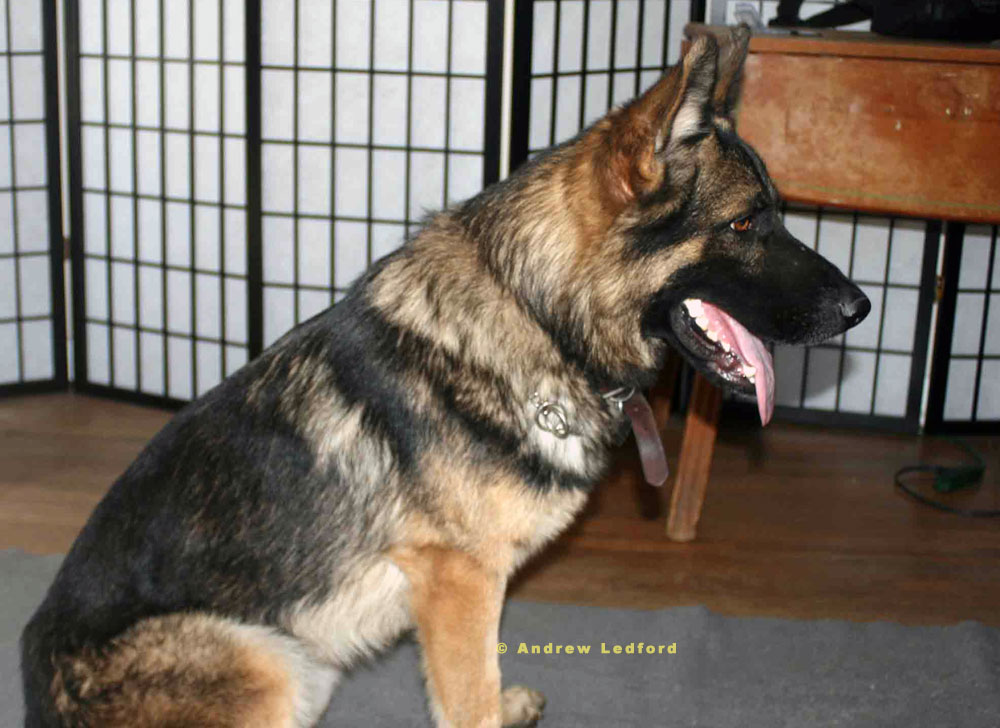
Puppy training can start at 7 weeks with an in-home puppy training program. Although pet dogs are now my main focus I have a background in protection dogs, security k-9s, police dogs, and dogs for television and film. I have also co-developed pet therapy programs for the Veterans Hospital in the San Fernando Valley, Del Amo Hospital, Psychiatric Service Dogs, and Torrance Memorial Hospital; work that included training dogs for human post-stroke neuroplasticity research.
We will soon add new programs that go beyond basic pet behavior. I am looking for a location for advanced dog training classes.
Next: Teaching “Sit" as an example of Mixed Dog training.
Start enjoying the benefits of a great relationship with your special pet….
Call me – Andrew Ledford today at
714-827-4058