Teaching the Sit: Why Your Training Method Matters More Than You Think
From the Kohler method to food luring to social cues; a look at what really works, and why timing is of paramount importance.
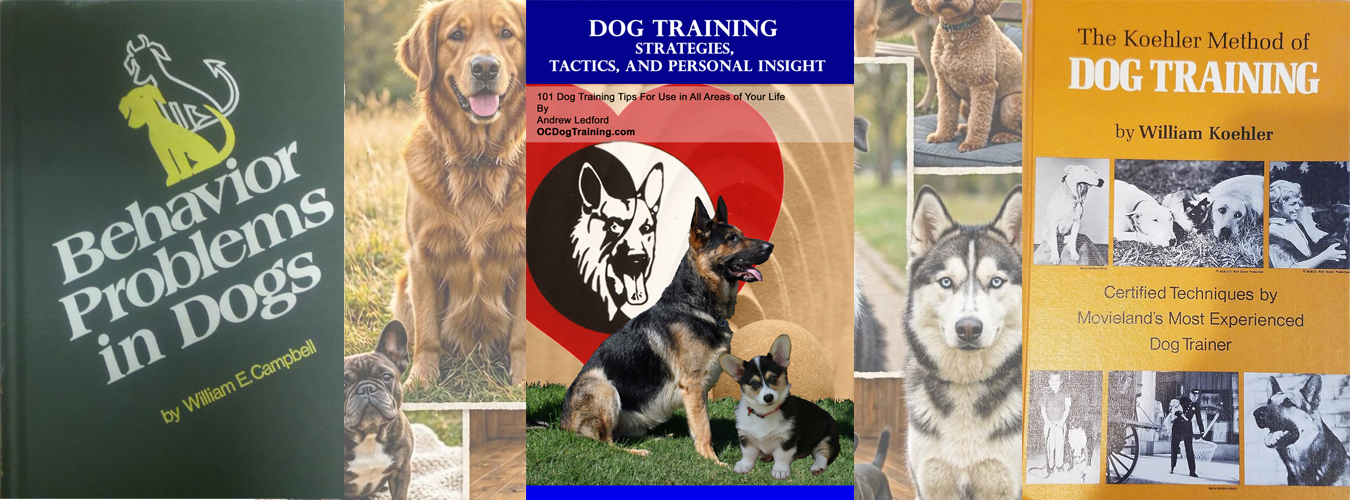
I have been rereading William Campbell's book Behavior Problems in Dogs, mainly because I attributed some information to him in my new book and needed to confirm the source. It has been many years since I read this book. But it was one of the first books on dog behavior and problem solving I read. That was when I was working for Dr. Tong at Magnolia Animal Hospital in Long Beach CA. I was most likely in my very early 20s. Right after I worked as a manager for a security dog guard company in Long Beach CA. That was right before I started working for Man Dogs, another K-9 security company, as their primary trainer. If you have attended any of my non dog public speaking talks many of the best stories are from when I was working for Man Dogs.
If you've read William Campbell's Behavior Problems in Dogs, you may have come across his critique of the push-and-pull method for teaching a sit. His concern was that dogs trained this way respond to the tactile cue rather than the verbal command. This is a valid point, I often critique clients on using too much pushing and not enough timing and positioning when teaching with this method. In addition many people get the command, response, reward sequence a little wrong as well. Teaching the “Sit” does show how different systems work at bringing a behavior under stimulus control.
His disapproval of the push-pull to teach “Sit” got me thinking about the Kohler method, and how people misunderstand some of its foundational principles.
The Kohler Method: What People Get Wrong
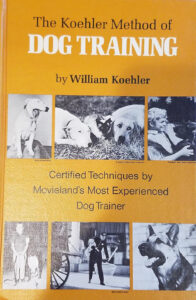
William Kohler had a reputation as a heavy leash corrector. His reputation for using a lot of force has prejudiced how people interpret his work. But if you've actually trained with his method, you know he did not start the sitting drills with sit corrections. Kohler emphasized working through the physical placement of the dog, patiently and repeatedly, until the “Sit” was automatic and reliable before any significant correction was introduced. This is a good lesson for all styles of training. Teach a behavior until it is super reliable before you correct the dog for not following through. That is if you are going to use corrections. If you are only using positive reinforcement it is a little different, but you still need to condition the response to be extremely reliable.
Teaching “Sit” with the Kohler Method demonstrates that the foundational phase needs to be established before corrections. Perhaps a solid foundation can even replace the need for corrections. A dog that has been guided into a sit hundreds or thousands of times, until the behavior is almost reflexive, will respond differently than a dog who has not. At that point, even a relatively mild correction is quite instructive. And often well scheduled positive reinforcement even more so. Deviating slightly from the Kohler Method, if the dog is well-trained and highly responsive, you may find that an instructive reprimand, social correction, or a slight instructive touch strategically placed is all that is needed.
The point is, heavy corrections aren't a requirement when you start teaching “Sit” with the Kohler's method. The key here is Start. I think we can apply this quote from Bruce Lee "Absorb what is useful, discard what is not, add what is uniquely your own.” for understanding the useful parts of the Kohler Method.
In Buddhism I believe there is a saying that there is more than one Path, more than one way, to the top of the mountain, and there is more than one way to teach “Sit.” It was Michael Porter who said there is no one best way, business, strategy, etc: in this case, method for teaching “Sit.” But there can be a best for one individual, or at least a more appropriate one. Depending on the dog, the handler, and the training context, any of the following approaches can work well. However, I usually teach them all as an integrated multisensory teaching/training system.
“Sit” with spatial positioning
Body positioning and eye contact, the spatial orientation display. No physical touch at all. To do this step back, make eye contact, and use your body to invite the dog into a sit. This is a spatial orientation or spatial positioning drill. In humans this would be considered a kinesics affect display. It is subtle, but surprisingly effective when done consistently. After the sit, the dog should (at least occasionally) receive some type of positive reinforcement, this could be talk, touch, praise, toy, or a treat.
The Food Lure “Sit”
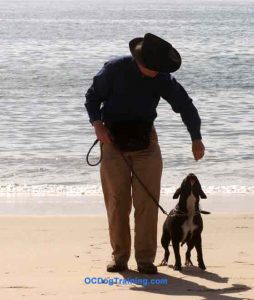
Using a food lure is a very popular and easy way to teach “Sit.” Here you are using the food to lure the dog into position with a treat. After the sit give the treat as a reward. After the dog is fairly reliable at sitting, put the behavior on command. One important element of food lure/reinforcements training is to condition praise to take on some of the properties of the food. I like using “Good" as the conditioned reward. This is for a praised based training system. If you are using a clicker then it’s slightly different. Without reliably training a conditioned verbal reward, most praise won't work as well as the handler thinks it will.
While Campbell was not a big fan of food reinforcement training he did believe in using praise. And so do I. I agree with Campbell in that most people give praise too often and for no apparent reason. This creates a problem where the value of the praise is diluted. As the praise loses its meaning its effectiveness is also lost. When you're talking to and praising your dog constantly, verbal praise and even physical praise loses some, to a great deal of its reinforcing value. I’m fairly quiet most of the time and reserve praise for when the dog is doing a desired behavior. This contrast, along with conditioning praise using other primary reinforcers will make it more meaningful.
“Sit” With the Leash and Collar
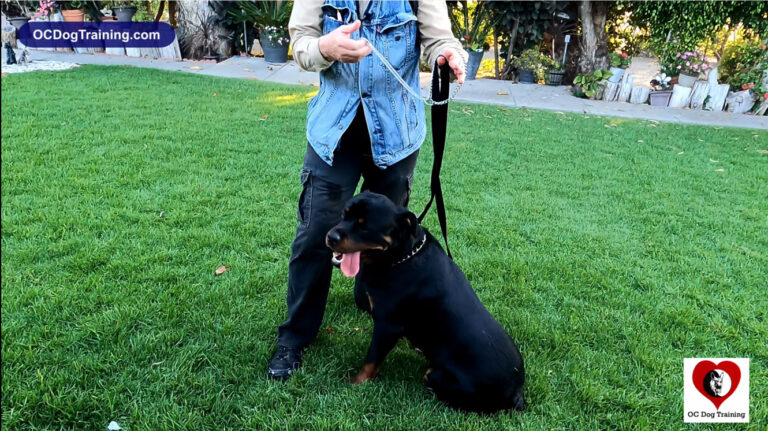
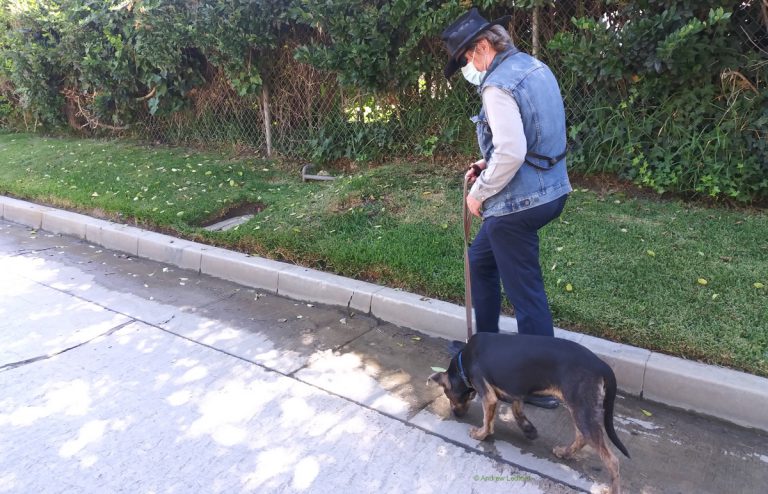
Leash and collar placement; When teaching a physical sit using the leash, the mechanics matter a great deal. Getting the angles of movement and the ratio of push and pull right determines if a dog learns to sit on a verbal command or if they only respond to the tactile cue of the hand pushing down toward the tail.
The Mechanics of a Good Leash Sit
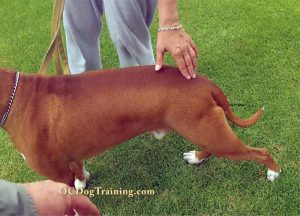
Campbell's concern about push-and-pull was specifically about how the tactile cue can overshadow the verbal command. While this can be true, I don't want to abandon physical guidance completely. To get command control when using a tactile cue we need to use a combination of physical guidance and good timing with how the cues are sequenced.
A good general rule to keep in mind is that it’s what the dog attends to first that usually controls the behavior. So once the dog is performing the behavior reliably, start giving the command before the behavior.
Here's what I've found works:
80%
Leash tension; upward, at roughly 45° forward
20%
Downward pressure on the hindquarters
The 45-degree angle is deliberate, it roughly matches the angle of the dog's spine while sitting. This makes it so the upward movement is working with the dog’s skeletal structure rather than against it. Pulling forward (not backward) is also important. When you push down on the hindquarters, place your hand as far back toward the tail as possible to avoid putting pressure on the spinal column. The command needs to be delivered in the proper order to be effectively associated with the behavior. When all the elements come together with the proper timing the dog will connect the verbal cue to the behavior. If teaching “Sit” with any one technique you’ll find there are other secondary cues the dog will start responding to. This is one reason for doing multimodal training. We want the dog to learn the behavior without relying on one set of secondary cues.
Putting It All Together
In practice, I teach the sit through several channels at once. If possible I like to use body positioning and non-verbal communication to elicit the behavior. In almost all training programs I also use food reinforcement to reward and shape it. I teach the “Sit” with the leash and collar for a variety of reasons. Using the leash and collar for guidance while incorporating the mechanics above can give an additional degree of control that’s often needed for difficult dogs or highly distracting conditions.
None of these methods are mutually exclusive. A dog trained through all of them ends up with a “Sit” that holds up across multiple scenarios. This will give you a greater degree of control in a wide variety of situations.
Get the foundation right, be precise with your mechanics, mind your timing, and for many dogs you'll have a reliable “Sit” without the heavy corrections.
Until next time, I am wishing you the very best in dogs and in life.
Andrew Ledford
714-827-4058
Next: About Andrew