Tip 1 from Dog Training Strategies, Tactics, and Personal Insight Book
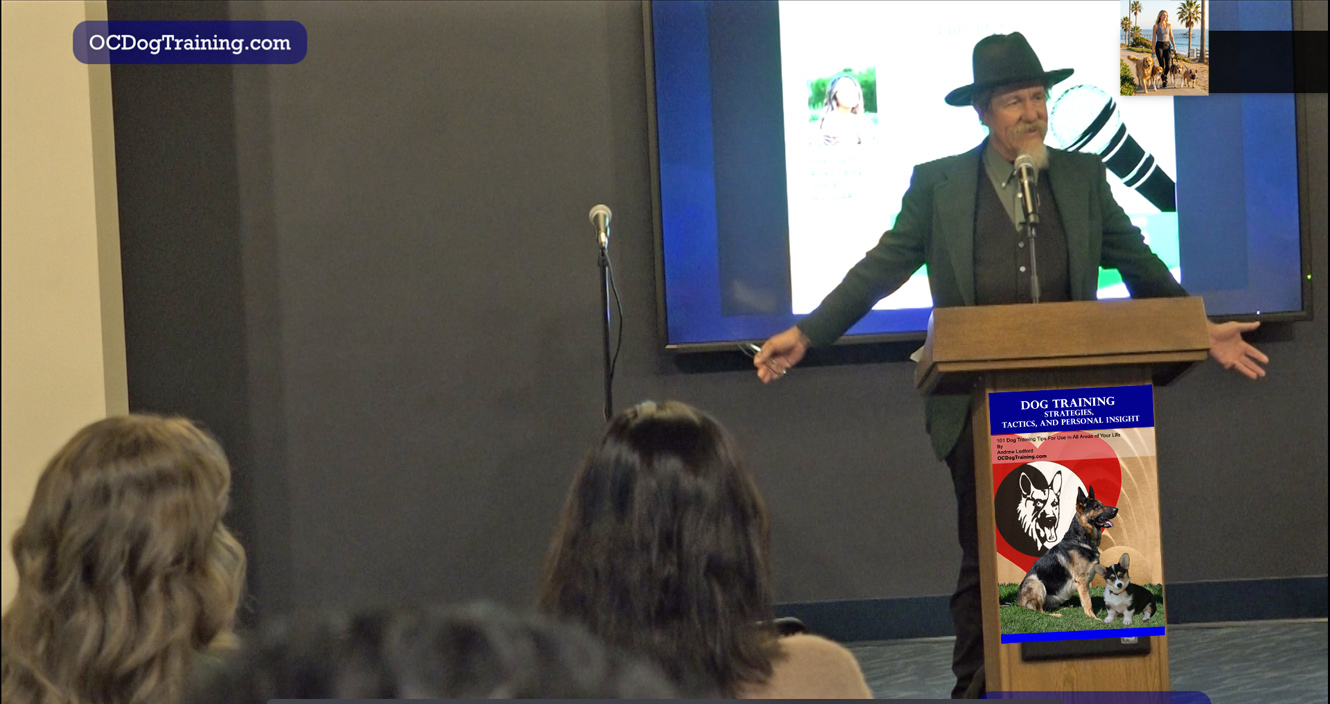
I did a reading of the firs part of my book “Dog Training Strategies, Tactics, and Personal Insight” at the Library in Anaheim California.
Here is a partial machine generated transcript from the video.
The book is called “Dog Training Strategies, Tactics, and Personal Insight.” The First dog website I had was 101 Dog Training Tips. So that is the subtitle. And I have it broken up into 101 tips. So Dog Training Tip number one, terminology, social structure, and semantics, dog packs, and dominance hierarchies. Dog behavior can be more complex and more varied than most people think. I want to start with a few contentious issues commonly encountered among contemporary dog trainers and behaviors.
Yes, I’m talking about two fundamental ideas about dog behavior that have been incorporated into the current dog training narrative. An interesting aspect of this part of the human dog narrative is that it has evolved its own rich and useful vocabulary. I’m talking about dog packs and dominance hierarchies.
First, I often use a somewhat colloquial vocabulary. I know it’s fashionable for a growing number of dog experts to get their knickers in a knot when anybody talks about dog packs and dominance. While it is fashionable in a certain clique to teach that dogs never naturally form packs,
I will use the term to describe groups of dogs that more or less live together.
However, I have also seen all kinds of social organizations within dog groups from single dogs that don’t like any other dog
to large colonies occupying permanent den sites.
Within this variation are some groups of dogs that look a lot like what even the there is no such thing as dog pack groups may call a pack.
Although I could be wrong or it could be that the kind of dogs I was observing were different from what most researchers observe.
So this is because I was in Taiwan and I was watching Taiwanese dogs or European mixes and Taiwanese mixes. And Taiwanese dogs are a lot like dingoes. All the dogs throughout Southeast Asia, they are dingo-like, all related.
What I’ve noticed is that the size and social structure of groups of dogs as well as their diet changes according to the environment. I’ve also seen more loosely attached groups where the makeup of the group was more transitory. I think of this as a fission fusion social structure. And this is what most modern behaviors think of dog groups or groups of dogs. Even in these groups there seemed to be a kind of social hierarchy. However, it was not the alpha dominant over ruler that some might think of. But there was definitely a top dog. These groups occupied hills with access to the most desirable resources.
And an interesting thing about this is the word dog in the English language is a huge mystery. But the very first time anything like dog is mentioned, I think it was Old English or Middle English, it was a compound word about dog hill. So I think the same thing is going on now as what’s going on way back then in Old English.
These dogs on dog hills, these tended to be mostly bachelor groups. Although the composition of the groups changed as they moved away from the most resource rich hill. The hill with the most outgoing and bravest dogs, most confident, least fearful, had access to the most females and the best food resources.