
Evidence Based Dog Training: Classic Methods Supported by Broader Scientific Research”
Standard Dog Training: Plus the Extra Science That Makes It Work Even Better.
This article about my style of dog training that’s enhanced by broader scientific research and was inspired by Artificial Intelligence. When I have done an AI search on myself in the past, AI would say I used a non-standard approach to dog training. Which is not entirely true. It most likely mistook my applications of innovative uses of evidence based cross‑domain research as non-standard. I often look outside the dog training field for information and research that will be useful for dog training. All of the training that I do conforms to standard behavior theory and/or principles from ethology (animal behavior.) However, I do admit to going out of my way to find new ways of doing behavioral design. In my youth I would incorporate interesting ideas into my training programs that are now standard. So at that time my training was a non standard approach but used well established training theory. I imagine I am still doing this. Now the techniques I used in those earlier days are well known and used by many other trainers. When a technique becomes mainstream I tend to quit accentuating it as much as when it seems novel.
I will give three examples of this:
- The first is using food as a reinforcer for positive reinforcement training. When I was a youngster the majority of people said you could not train with food and reinforcement theory. Now it is one of the dominant schools of dog training.
- The Premac Principle. Or using an established habit/behavior to reward a new behavior. At one time this was little known and seldom used. Now it can be found mentioned in many places in dog training literature.
- The work of Joseph Wolpe who was a human psychiatrist and behavior therapist who adapted research in animal behavior and applied it to humans. His work underpins modern desensitization and counter conditioning in dogs. Now he is often mentioned in dog training literature. So his ideas are now much more mainstream than when I started incorporating his ideas into training. However, at one time they were considered non-standard, even though they were taken from and adhered to standard behavior theory.
AI and Distorted Information.
It seems that AI is not below accentuating (sharpening) certain information and discounting (leveling) other information. Sharpening is a cognitive psychology term for exaggerating some details and leveling for downplaying others. I am going to be doing a public presentation (talk) on this phenomena in the near future. I need to say I have asked AI for this same information about my training when starting this article and it did not give the distorted information that prompted the article. I need to mention that AI responses can vary depending on phrasing, model version, or data emphasis.
So how is it that I come up with new uses for established research?
My interests extend far and wide and cover diverse subjects and domains. I tend to read and explore more broadly than most people. Therefore I can combine and synthesize information from different fields. This may include reading research papers (now digital) from various domains, reading books on a variety of subjects, and attending seminars and now webinars, as well as online lectures and other videos (often from universities or museums.)
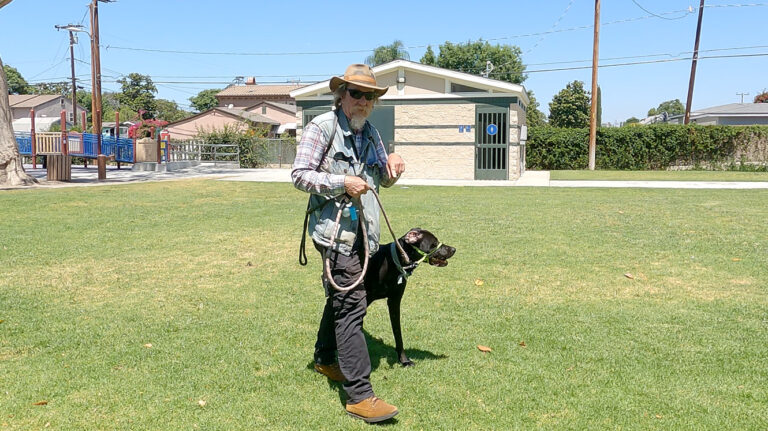
Working on Heel using Positive reinforcement and learning theory. This is a standard dog training technique

Feral Dogs hunting rats in Taiwan (ethology.) This is normal dog behavior. Although at the time I took this photo the consensus of the dog training group I belonged to said, feral dogs don't hunt.
This Is How My Mind Works: I Follow Connections Across Fields And Then Test How They Apply To Behavior.
When writing this article I had been in talks for doing a presentation with a seminar promoter about affirmations and human behavior. I am also starting to do some innovative dog training programs where this type of information may be useful. To give you an idea of my creative process I first started writing how I use and think about affirmation. This took on a distinctly behavioristic approach. This is how I always have thought about affirmations and I still do. However, I also started reading research papers about affirmations. The research changed how I view affirmations and how they can be used. I also happen to be rereading some older ethology books and see how animal behavior corresponds nicely, although somewhat abstractly, with the new research on affirmations. The morning of starting this article I also attended a psychology webinar on attachment styles and see a correlation there with both using affirmations and the ethology research. In addition, recent research on the human-dog dyad(s) also sheds light on attachment styles and how this affects a dog's behavior.
Human attachment style, dog behavior, and the secondary socialization period.
Interestingly enough, human attachment styles can influence many types of dog behavior during a dog's early years. Human attachment style may be particularly relevant during what can be thought of as a secondary socialization period. The secondary socialization period can be colloquially thought of as adolescents through early adulthood. I am referencing new research to support and formally incorporate this into my training programs. Although I have been advocating the idea since the 80s, until now it has not been used in a formal training protocol. I have traditionally used information about the secondary socialization period more as background information, now it will be presented with additional information and as more empirically supported. Here is an article supporting the changes a dog's brain goes through from a puppy up through the secondary socialization period, "Developmental features of sleep electrophysiology in family dogs." I believe my original interest in secondary socialization periods and their affect on dogs was sparked by either the work of Konrad Lorenz or Desmon Morris in combination with training dog for law enforcement. The concept was developed through both theory and hands on experience. At that time there was a lot of evidence this was occurring, but I don't think there was any hard empirical research done on the critical importance of the secondary socialization period in dogs.
Practical application of research, narrative, and experience on dogs and humans
Over the last few months I’ve been developing a way to incorporate information from both affirmations and human attachment styles into dog training. While affirmations may only help a very small subset of people I work with, I can think of at least one who would most likely benefit from this. In addition I see how both types of information can be useful for writing programs in senior living facilities. Legacy writing gives residents continued meaning while making them more resilient to changing living conditions. You can see my senior writing presentation on my personal website blog at Andrew Ledford . com
So it’s not that I use non standard techniques, but I do use little known established standard techniques in nonstandard ways.
Until next time, I am wishing you the very best in dogs and in life.
Andrew Ledford
714-827-4058
Next: Mixed and Balanced Dog training