When to Use and How to Use a Choke Chain or Slip Collar
Choke Chains and Slip Collars:
The Good, The Bad, and The Ugly
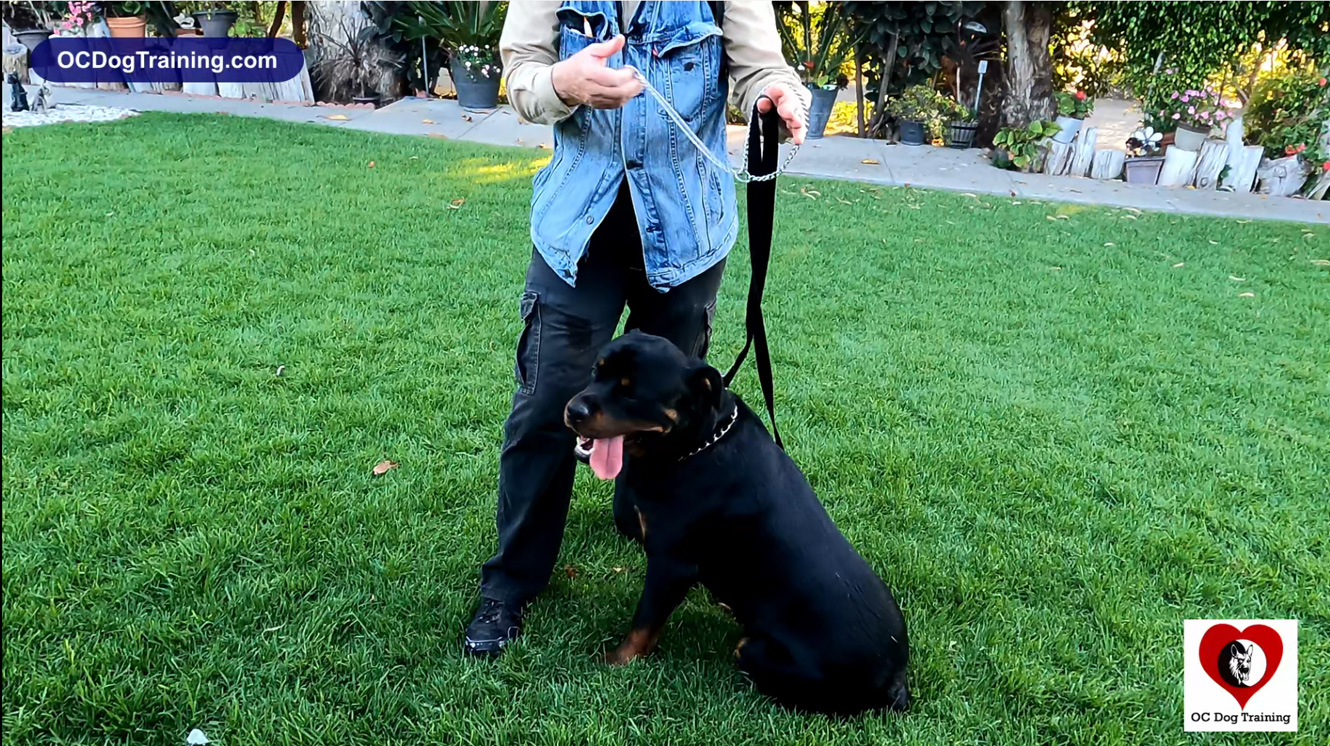
Slip collars, which most people know as choke collars or choke chains, are among the more controversial pieces of training equipment out there. I want to share my perspective on them, including when I use them and why I recommend them even to clients who aren't sure they want one. I’ll also go over the effective use of the slip collar in various training scenarios. While focused on slip collars this could also be considered a general collar post as well. I will touch lightly on some of the potential concerns of using flat collars, head collars, and harnesses.
First, a little context about my own approach. I am a fairly flexible trainer who enjoys working across a wide range of methods. I find it genuinely interesting to train using only positive reinforcement. Training a dog using only positive reinforcement is surprisingly more difficult than one would think and requires a great deal of awareness and discipline.
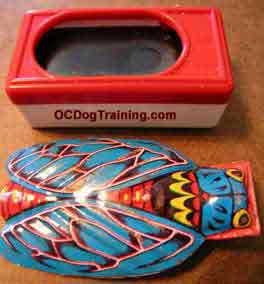
Training with only positive reinforcement is most easily done with clicker training. The reason clicker training works well for this is because it eliminates much of the human and social interaction that’s involved in other types of training. I have also found that it is most easily done in a kennel training environment, although I’ve done it with dogs staying with me. When doing this type of training I’ve found that the handler needs to be constantly alert to the subtle body language that could be interpreted as a correction. All positive reinforcement training in a social environment is not a human’s natural default behavior. At least not in the cultural groups I work with the most.
But just because we default to, at least some assertive behavior, does not mean we should not try to use as much positive reinforcement as possible for the situation. Since I was using a lot of positive reinforcement (food rewards) before positive reinforcement was cool, I tend to use it in much of my training. But the reality is that most clients, even those who say they want an all-positive approach are not ready or willing to put an all-positive program into practice. In my programs I observe what people are doing, I see what equipment they are using, their dog’s personality, and build a program around what will actually work for them and their dog.
Slip Collar For Back Up and Safety
Even when I’m not using a slip collar as a primary training tool, I will often tell clients to have one on hand. There are several practical reasons for this.
The first is safety. Dogs that slip out of flat collars or harnesses are a real concern, and a slip collar eliminates that risk. When a dog can get free and run into traffic, or for small dogs, take off and get eaten by a coyote, the stakes are too high to leave things to chance. A slip collar is one way I help keep that from happening
I’ve seen this play out more times than I can count in veterinarian parking lots. As I am approaching the veterinarian office, a dog slips its flat collar or pulls free of its harness and takes off. I carry a slip lead, and more than once I have lassoed a runaway dog before anything bad happened. It might not seem like much, but to the panicked owner it drives the point home in a frightening and emotionally impactful way. The run away dog that can’t be caught is the dog that gets hurt or worse.
The second reason is that I often use it as a backup alongside another collar. If the primary collar comes apart or breaks, the slip collar keeps the dog connected. Many people don’t feel comfortable just having the leash connected to a head collar. If you’re training with a pinch collar, using some kind of slip collar should be a standard operating practice. Pinch collars often come apart during extreme activity. For this backup to work, the slip collar needs to be longer than one used as the primary training tool. Both of these demonstrate a more passive use of the slip collar in training scenarios
A Safer Option Than You Might Expect
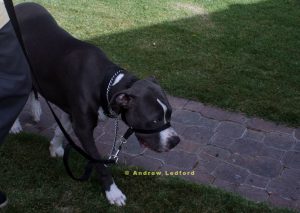
Here is something that surprises a lot of people. A properly used slip collar is often safer than a flat collar, particularly on a young puppy. I have seen flat collars cause injuries. I have never seen a correctly used slip collar do the same. When we’re talking about using it with pups, that means a very light, very fast, snappy correction. Much lighter than what most people will do with a flat collar. It is faster than a flat collar leash prompt and lighter than a flat collar leash pull.
The key phrase is "correctly used." A slip collar used as a quick reminder, something like a light tap on the shoulder, should cause no problems at all. The trouble comes when people don’t develop a feel for using it properly, and that takes time and practice. It’s a type of sensitivity most people need to work at developing. Once learned, this sensitivity can transfer to other areas of dog handling.
What About Neck and Tracheal Injury?
This is the objection I hear most often, and it deserves an answer.
Yes, a slip collar can cause injury. So can a flat collar, a harness, a pinch collar, or a head collar. Any piece of equipment used incorrectly or left on an unsupervised dog carries risk. It’s not so much that a tool can cause harm, but whether it causes harm when used correctly.
Flat collars usually don't get the same scrutiny as slip collars. But there is some research on flat collars and harnesses. According to this research all collars should cause harm to dogs that pull on walks.
Pressure and force on the canine neck when exercised using a collar and leash
A. Hunter, S. Blake⁎, R. Ferro De Godoy
Writtle University College, Lordship Rd, Writtle, Chelmsford, Essex CM1 3RR, United Kingdom
There is additional research that includes many harnesses as a cause for potential injury. However, if the research is accurate, I always wonder why all 8 year old dogs do not have these injuries. A lot of the research is based on comparisons with other mammals and some is done by or funded by organizations that are biased towards a certain point of view. Some research also indicates that the slip collar vs the flat collar potential for injury is related to intensity and duration. Here I am thinking of a few weeks for the slip collar compared to nine years of pulling into a flat collar. So while using a slip collar may increase the intensity it is also more likely to decrease the duration of pulling.
The injuries people associate with collars almost always come down to one of four things:
- The collar being left on when the dog is unsupervised. I have seen dogs get a slip collar caught on a water spigot. If not caught in time, that can be fatal. The solution, take the collar off the dog when not training. I have also seen where a dog gets its jaw trapped in another dog's flat collar. This is quite distressing. I have a special strap cutting knife for these situations if dogs are staying with me. I take a lot of precautions, so it has never happened when dogs are with me, but I am prepared in case it does. They also make special flat safety collars for hound dogs, because not being able to slip a flat collar when in the bush can have serious consequences.
- Chronic leash tension where the dog is constantly pulling into a tight collar has the potential to cause injuries. Much of the research on the potentially harmful effect of flat collars has been done based on the amount of force with which a dog pulls. The research on harnesses often focused on how hard they pull and how it causes an unnatural gait, potentially leading to repetitive stress injuries. The slip collar, used correctly, actually reduces this risk because the leash is loose most of the time and tight only for a moment.
- Corrections that are too hard and too slow have the potential of causing injuries. I have seen some pretty hard corrections administered to working dogs without serious side effects. Some of my first dog training jobs as a youth were with police, security, and guard dogs. Much of this type of training would most likely not be done with pet dogs. Pet dog training is often quite different than police or military dog training.
- Using a flat collar like a slip collar. I have never seen any research on this. However, it was a common training practice at one point. On adult dogs I did not see serious problems. On young puppies I did, and I saw it more than once. A flat collar doesn’t release the way a slip collar does. The release is a difference that matters more than most people realize.
None of those are the collar's fault. They are handling problems.
A properly used slip collar is on the dog during training and off the dog when training is done. The leash is kept loose except for the moment of the correction or prompt. The correction itself is fast and for most pet dogs light to moderate, not a sustained pull. Under these conditions, I have not seen injury in over 35 years of working with dogs.
There have always been breeds and types of dogs where I am much more cautious about using any kind of collar. Probably more because of intraocular pressure and eye health being the major concern, but tracheal damage concerns are also to be considered. Even when I was only training working dogs it was widely assumed that dogs with pushed in faces (brachycephalic) and bulging eyes were more likely to get injured by neck pressure from a collar.
Small dogs and toy breeds are another group of dogs where I am going to be especially careful about collar choice and correction intensity. I need to mention that here in California where I train, these are the dogs most at risk of being carried away by coyotes. These attacks happen quickly and often without any warning. Not only the size of the dog but the breed will often determine what equipment I'm using. I am going to be much more cautious using any training equipment with an Italian Greyhound than with a terrier. For dogs with a more delicate structure I am more likely to use different equipment. This could either be a harness or martingale as the primary attachment point. A martingale collar is like a limited slip collar, and its use is mentioned in the following Marcella Ridgway paper. However, even with the most delicate dogs I want to use a slip collar as a backup safety measure. With perhaps some exceptions for the martingale. Many people underestimate the coyote risk in urban and suburban environments, and for small dogs it can be fatal. Keeping a Small Dog from slipping out of its training equipment is of utmost importance.
An observation that’s also worth mentioning is that most veterinarians use slip leads when handling dogs in their facilities. Veterinarians choose slip leads because they need a reliable, quick connection with dogs they do not know, in high-stress situations.
Before I leave this section I want to quote a paper by Marcella Ridgway - Health implications of dog-worn equipment: a review of known and alleged physical risks - College of Veterinary Medicine, University of Illinois Urbana–Champaign, Urbana, IL, United States
“There is a paucity of evidence regarding best designs and best practices for use of standard dog equipment and, while potential for harmful impacts on dogs’ health is suspected, little evidence exists to define the actual risks. Isolated case reports document severe trauma associated with misuse of collars.”
We should pay attention to the passage “little evidence” and “Isolated case reports.”
The Progression I Use
On the first lesson, I usually don’t even use it, even if it is to be used later. My early lessons focus on food, play, and praise, along with teaching proper hand positioning and body language. The collar comes into play more actively on the second lesson. This is where I generally go over how to properly put the collar on the dog and explain how it should be used. To put the collar on properly the material connected to the live ring, that is the ring the leash is connected to, running over the top of the dog’s neck, with the rings on the handler side of the dog. I have a page that goes over fitting and putting the collar on correctly at Dog Training Slip Collars. To use the collar properly requires the proper leash handling. Sometime on the first and almost always by the second lesson we go over the leash handling fundamentals. This includes the proper way to hold the leash both for ease of dog training and also for the safety of the handler. One of the most important skills new handlers need to learn is how to keep the leash loose when walking the dog. Because a tight leash teaches the dog to pull.
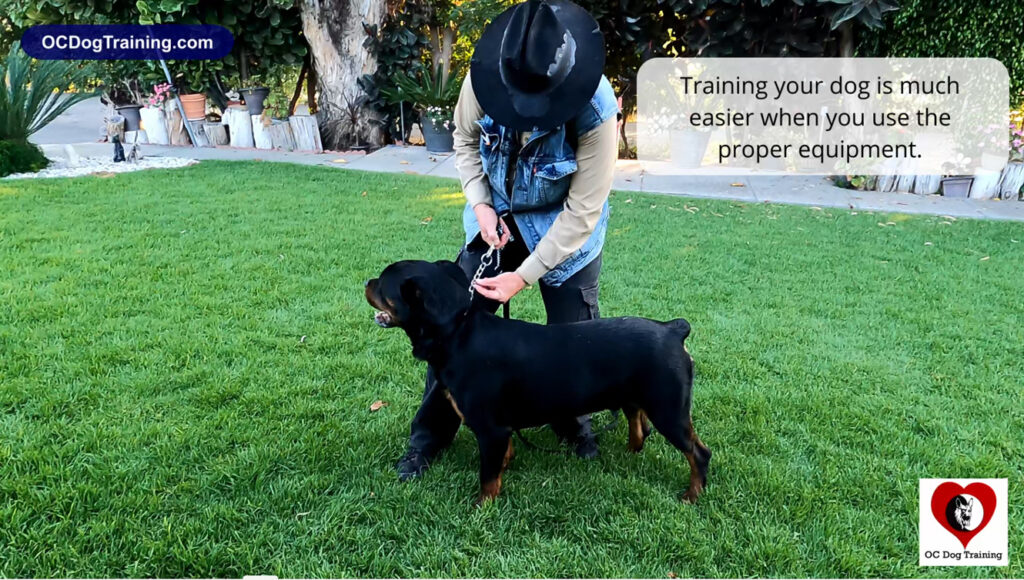
For most dogs, my general progression is to start with the slip collar and then move to a head collar as the dog builds some understanding of what is being asked. Many dogs resist the head collar at first. This is why I actively teach the dog to accept the head collar before we use it. This usually takes the form of some kind of food reinforcement training. By the time we start using the head collar the dog already knows some basic drills. This combined training makes it much easier to transition from slip collar to head collar. Once the dog accepts the head collar you will have more control with less effort. However, if a client tells me at the beginning they don’t want to use a slip collar there are other ways we can start most dogs. I also have some safety protocols for using other types of collars. I need to mention other types of collars carry their own risks, some of which were mentioned earlier.
Throughout all of this, I am focused on positive reinforcement. Food, social interaction, and environmental rewards all matter. In the training program positive reinforcement isn’t just tacked on to a leash program. They are a core component to how the training program is designed. They all work as a system.
How to Use a Slip Collar as an Active Training Tool
There are a few distinct ways to use a slip collar effectively.
The first is as a correction. A correction is a short, sharp snap of the leash. The leash goes loose just as fast, or faster, than it goes tight. A light, quick correction is almost always better than a slow, hard pull. For all dogs the timing matters more than the force. For most dogs a light to moderate correction is all that's needed. If you're using a head collar it is the opposite of this and you do not want a snappy correction. With the head collar it is a steady pull.
The second is as a prompt. A very light touch on the leash can get a response from the dog, and how you handle the dog after that determines what happens next. Most people use leash prompts at the wrong moment and with too much force, which leads to overhandling and makes it less effective or teaches an undesirable behavior.
The third is to guide the dog. This requires some finesse and often the proper use of body language.
What you want to avoid is dragging the dog around like a fish on the end of a line. If the leash is staying tight, either you are pulling the dog or the dog is pulling into the leash. A tight leash will also teach the dog to pull by eliciting a counter pressure response. This is where the dog pulls into the leash as hard as you are pulling it back or harder.
The Bigger Issue: Overhandling
Getting back to overhandling. One of the most common problems I see with the slip collar, actually with all collars and with leash work in general, is what I call overhandling. Too much force, wrong timing, and a constant tight leash. The most obvious types of overhandling are fairly easy to see and develop training to prevent. However, the more subtle forms are easy for an experienced trainer to see and hard to explain in words. This is where experience will help you develop sensitivity to the dog and to the leash. You have to feel it to understand it, and you get there by doing drills. The sensitivity drills often start before you ever use a leash and collar with the first food reinforcement training drills.
Drills build skills. That is not just a saying. It is the whole point of the structured repetition I build into training programs. The right touch of the leash becomes natural over time.
This is also one reason the head collar works so well for many people. It is more intuitive. You do not have to think as hard about leash handling to get results. Since we can only hold about 5 to 7 bits of information in short term memory, this makes the head collar quite helpful for the average person. In a dog training program you will be taking in a lot of new procedural information as well as maintaining environmental awareness. That said, good leash mechanics makes the head collar more effective too. Using good biomechanics for the human and the dog makes all training more effective regardless of what equipment you use.
After over 35 years of dog training I still use the slip collar regularly, often as a starting point and almost always as a safety restraint. When a slip collar is used properly it works. More importantly, it ensures the dog's safety. It gives the handler a secure, low-escape-risk connection. When the handler learns to use the slip collar correctly, it will give a great deal more control and also becomes a useful line of communication. Taken off when training is done and matching the technique used to the individual dog, it is one of the more practical and versatile tools you can have.
Your Dog Trainer Andrew Ledford Serving 714 Orange County, Long Beach, all the 562 as well as parts of the Gabriel Valley from Hacienda Heights to Pasadena.
If you need help with your puppy or dog’s behavior please give me a call today I will do a free phone evaluation and if you would like to move forward we can make an appointment.
Andrew Ledford
OC Dog Training Network
714-827-4058